Showing posts with label Recipes. Show all posts

05 July 2015

Home


Welcome, 

Have you ever thought about what life would be like without all of the sounds that we take for granted?  Phones, cars, television, planes, air conditioning, and motors all make a peculiar noise.   Are there days when just the sirens of rescue units stress you out?   

Do you sometimes feel that you would enjoy spending just one day outside in warm sunshine listening to the sounds of gurgling streams and birds chirping in the trees?

What about the smells around about you? Have you ever thought about the odors that you take for granted because they are part of your life and so familiar to you? Do you know that they are very different than the ones our grandparents experienced? Homemade bread and wood burning in the stove were part of their daily life.  Have  you ever smelled soil rich with forest loam right after a warm spring rain?


Once, I asked my grandfather what he missed most in his life that his grandparents had taken for granted as being part of their own.  He never hesitated an instant before he replied.  Lumber was the single word he uttered with such emotion that it startled me. 

Seeing my reaction, he went on to explain that his grandfather had a true understanding of the forest which he had  never been able to share because his  father never saw the value in his learning about any of it. It had become possible in his own father's lifetime to go to a sawmill and order whatever kind of lumber needed to build a house or to lay a floor.  His grandfather had gained his knowledge of timber from working with past generations of his family. 

My grandfather went onto say that  his grandfather could tell the board feet in any tree from simply looking at it as it stood in the forest. To know the quality and usable board feet of lumber in a tree before it was cut was a skill that my grandfather was sorry that he had never had the opportunity to learn.  It was a skill that he was unable to pass down to members of his own family.

A drastic new way of life emerged during my grandfather's lifetime.  As a young man he traveled by horseback and yet, before his death he sat in his own home and watched a man land upon the moon.  Within his lifetime the telegraph was replaced by telephones, radios and television. He remembered a time when all consumed food was produced at home.  Electricity and indoor plumbing were marvelous inventions that had became part of his own life which his own grandparents would never have believed possible. 

Indeed much has changed in just the past few generations.  Have you ever given thought as to what some of these changes may have made in the life of your own family?

I do hope that you will join me as we travel back in time to the days of not so long ago and explore all facets of life as it was lived by our families. 

                                                                      Until next time,

                                                                             Billie Jo 
                                                                      
pages

17 May 2015

Sassafras I

Springtime in the Blue Ridge
Springtime in the mountains is a wondrous thing to behold as all of nature rushes to renew itself.  If you are lucky enough to begin your journey near one of the foothills or in a hollow, you just might find a creek overflowing with rushing water to guide you into the mountain and up to its very top.
Look carefully at your surroundings; be careful where you step as the whole world is in the process of renewing itself at this time of year.  If you only look to see the filtering sunlight through the redbud bloom you just might miss seeing the lethargic snake which is blending in amid the rock and last winter's leaves that you are about to put your foot upon.
Sassafras trees are found in the eastern United States, from Canada to Florida, and also in Mexico.   This tree has a unique leaf pattern in that it produces leaves of three different shapes on the same tree. 
Some of our early local farmers saw the sassafras tree as a nuisance as it was normally found cluttering the cleared, "old Indian fields" which they needed for cropland.  Others believed that its wood would prevent chicken lice.  They used it to build their hen houses and the roosts for the chickens to perch on at night. Some believed that if it was burned, someone would die when the wood cracked and sputtered.
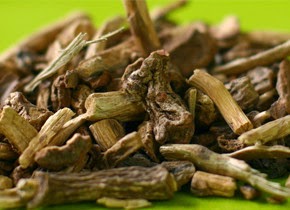
Regardless of whatever this tree was used for, everyone knew of its magical healing properties when the roots were chopped into pieces and used to make a springtime tea.  The tea was a tonic that was very well known by many of our nation's Native Americans.  The Cherokee used sassafras to purify the blood.  They also used it for a wide variety of other ailments including skin diseases, rheumatism and ague [a malarial fever characterized by regularly returning paroxysms, marked by successive cold, hot, and sweating fits, accompanied by malaise, pains in the bones and joints].  Some Native American tribes built their dugout canoes from sassafras wood.  Cajun folk use the sassafras leaves to make gumbo.  Sassafras is referred to the as the "Ague Tree" in many cultures.

There are two varieties of sassafras:
1. White sassafras grown in thick clusters from the three to six feet tall.  It has basically the same characteristics as red sassafras, but the bark does not turn pink nor red when the root is damaged.
2. Red sassafras is the most prized variety.  It is generally found on hills and ridges.  In the mountains it usually reaches a height of thirty plus feet.

In Montgomery County, Ohio is a specimen which is ninety feet tall and has a diameter of almost three and one half feet.  In Owensboro, Kentucky there is a one hundred foot sassafras tree with a circumference of twenty-one feet [seven yards] that is believed to be over three hundred years old.[1]
Sign for the tree below. 

Largest sassafras tree in the United States
I have found records where it has been determined that some sassafras trees have lived to be over one thousand years of age.  Can you imagine the tales they could tell if they could only speak?

William Bartram in his, "Observations on the Creek and Cherokee Indians Food Traditions,"[2] stated that "the country people of Carolina chop the vines [Bigonia Crucigera] to pieces together with china brier and sassafras roots, and boil them in their beer in the spring, for diet drink, in order to attenuate and purify the blood and juices." Perhaps this is the source which influenced early white settlers to make a beer by boiling young sassafras shoots in water, adding molasses and allowing this mixture to ferment.
Before the Jamestown settlement in Virginia, a company was formed in Bristol, England which sent two ships to the New World with the purpose of returning with cargoes of sassafras bark.  This was most probably due to the investigations made by either Raleigh's men or  the Roanoke colonists. Sassafras was the first forest product exported from what is now the mid-Atlantic region.  Sassafras most certainly smells like springtime itself.  Can you imagine sailing with a whole ship load?
Sassafras in the fall. 
The Cherokee made poultices to cleanse sores and wounds; they steeped the root bark and used it as a treatment for diarrhea or for "over-fatness."  The Cherokee emphasized that sassafras tea should never be taken for more than a week at a time.  Even though they were unaware of the word, "safrole" they were very attuned to the effects of the long term use of sassafras.

In the early 1960's, sassafras was pulled from the American market due to the fact that the bark on the sassafras root contains violate oils, eighty per cent of which is "safrole" which was proven to cause liver cancer in rats and mice when given in large doses.
Sassafras tea set upon a sassafras leaf designed quilt.
An Early Recipe for Sassafras Tea
Two to three sassafras roots chopped in pieces two or three inches long.  One quart of water. Boil roots in water until water is dark in color.  Remove from the heat and strain into a gallon crock or pot.  Sweeten to taste.  Note - roots maybe boiled over and over for several days as the flavor increases with repeat boilings.  Roots should be gathered in spring before sap rises.  [A necessary disclaimer: It is important to remember that the United States federal government banned the use of Sassafras in the early 1960's; therefore, this recipe is being given only as a historic note about how our families once lived and not as a recommended form of medicine.]
____________________
Sources:
[1] The National Forestry Association’s National Register.
[2] Bartram, William.  Observations on the Creek and  Cherokee Indians food traditions. Transaction of the American Ethnological Society.  Vol. 3. 1789.
e American Ethnological Society.  Vol. 3. 1789.

26 April 2015

A Journal - Elkton - McGaheysville, Virginia Area

Recently  I was given a packet containing some old family photos, a few letters, newspaper clippings and a bound composition book with  ruled pages. This volume has a black and white cardboard paper cover. As I examined the outside of this book,I found it's first entry was made well over a hundred years ago by a Miss Lottie Davis of Elkton,Virginia. 


Curiosity killed the cat and being a genealogist won out over what some will say is, "good common sense". I just had to know exactly who this Miss Lottie M.Davis was.  Without that knowledge how could any of us judge the true worth of what she had written in her "Journal"?


Miss Lottie M. Davis


Well, as it turns out, Miss Lottie was, indeed, from the Elkton - McGaheysville, Virginia area as had been her family since early settlement days.  


Miss Lottie M. Davis was the daughter of Hiram Franklin Davis and his first wife, Cora Lee Eppard, the daughter of Thomas J. Eppard and his wife Mary Ann Dean who had been married on the 10 May 1888. Cora Lee Eppard Davis died 18 Dec 1916.  She and Hiram were the parents of  Hurman [Herman?] L. Davis, Lottie M. Davis, Lelia Ethel Davis, Mabel E. Davis, Hiram F. Davis, Jr., Lawrence F. Davis, William Albert Davis, Harold Russel Davis, Beulah M. Davis, M. Norwood Davis.  [Note: William Albert Davis was called "Willie" on a census record, but he was also known locally as Bill Davis.  He should not be confused with William Henry "Willie" Davis who was the son of James Henry Clinton Davis and his wife, Rebecca Suzanne Comer.]


After Cora Lee Eppard Davis died in 1916, Hiram remarried to Mattie Edna Leap the daughter of Elijah [Elisha] "Alfred" Leap and his wife, Mary Virginia Armentrout.  Mattie was a descendant of the Leap, Warble, Sellers, Monger and Armentrout  families who settled in the McGaheysville - Elkton area.


Lottie M. Davis's grandparents were:
1. John Barton Davis and Sarah Elizabeth Samuels who were married 22 Sep 1859.
2. Thomas J. Eppard and Mary Ann Dean who were married in 1867.

Lottie M. Davis's great grandparents were:
1. James S. Davis and Barbara Ann Smith who were married 23 Aug 1834.
2. Joseph Hiram Samuels, Sr. and Mary Parmelia Eppard who were married 28 Aug 1828.
3. Reuben Eppard and Mary Susan [Sarah] Smith who were married 12 Feb 1837.
4. Dean who has not yet been determined and his wife.

Lottie M. Davis's great great grandparents:
1. Davis side not yet determined. [1880 Census states James S. Davis and his father were born in Maryland.]
2. Not yet determined. [1880 Census states that James S. Davis and his mother were born in Maryland].
3. James Smith, son of William Smith and Nancy Morris. 
4. Elizabeth Miller, daughter of Christian Miller and Catherine Conrad.
5. Joseph William Samuels
6. Frances "Fanny" Snelling.
7. John George Eppard [Ebert], son of Wendel Ebert.
8. Catherine Beasley.
9. John George Eppard [Ebert], son of Wendel Ebert.
10.Catherine Beasley.
11.William Smith
12.Nancy Morris.
13. Dean who has not yet determined.
14. Not yet determined.
15. Not yet proven. 
16. Not yet proven.


From the above, it is easy to determine that Miss Lottie M. Davis was related either by blood or marriage to almost every one who had settled in the McGaheysville or Elkton area.  She lived during three horrible wars: WWI, WWII, and Korea.


Miss Lottie M. Davis is buried in the Elk Run Cemetery in Elkton, Virginia.


Much to my surprise, this journal was not a typical notebook of household activity or even one for a farm or local business as one expects to run across every now and then.  There were no weather entries or any other such things as one would expect to find.  Instead to my astonishment and delight this book, with entries starting in the year 1911, contained things which the writer felt were truly important enough for her to always remember.  As I perused the book, I found that the entries were not always in order. 

It is my opinion, based upon studying this book, that over the years she entered information upon whatever was close at hand to ensure that she did not forget an exact day an event occurred.  Then she recopied that information into this book as she had time or perhaps found the previous notes she had made to herself.

In the following transcription, I placed the day of the month before both the month and the year in order to be positive there was no mistake made in writing the date. A lead pencil was used to make the original journal entries. Now, the pages of this volume are a beige-creamy color instead of the stark white it use to be, when it was new, a hundred plus years ago because of the acid found in the old paper. The writing on these pages is, at times, difficult to read even with the help of a strong magnifier; therefore, when I am unable to decipher an entry, a blank line will replace the letter or letters in question. Perhaps you should also be aware that I am inserting in brackets, near the original entry, additional information which I know to be true from other family, community, church or government records.


Due to the fact that this journal's content is extensive, it will be necessary to limit the number of pages which I am able to print on this site at any one time. Please also bear with me in understanding that as this site contains various topics, it will be necessary for me to rotate the subject matter among those topics.  In reality, this means that the pages from this journal will not be printed all at one time but must be rotated, along with the other subject matter.  I do know and fully understand that some of you are interested in the recipes while others are interested in only the military aspect of this blog post, so"please" bear with me as we move forward with this site which was designed in hopes that it would allow all of us a better understanding of life as it was lived in the colonies.


Oh, one other thing I forgot to mention, this journal does positively cite events in the lives of folk who lived in the Elkton - McGaheysville, Virginia area between 1911-1935. This means that if someone is listed as having died in 1911 at the age of eighty-eight years, that person would have been born ca. 1823, or eight years after the War of 1812.  In all probability they would have known their grandparents and some even their great grandparents.  These folk would most probably have served with George Washington's troops, many of whom were from this area.  Some of them may even have been your emigrant ancestor. Perhaps one or more of your elusive ancestors will be cited in this journal and you will know exactly what he or she was doing on that particular day of their life. So, even though you may be primarily interested in the recipes or perhaps the Holidays or something else entirely, you might find this section also worth your time to read.


The Journal of Miss Lottie Davis 


Inside the front cover of her journal she wrote the following recipe which I have not, as yet, tried.
Candy
 2 cups sugar,1/2 cup water, 1/2 cup milk, 1/2 cup nuts. 
Mix sugar. water in a large pan, bring to a boil, add milk and boil over a low flame until mixture forms a firm ball when tested in cold water. Move from fire and add nuts.  Beat until mixture is thick and creamy, but when cold [cut] in s_ [slices, squares?].

Part 1 - Page 1
Things Happening in 1911
25 May 1911 - Moved from Cambell [?] to Elkton.
26 May 1911 - Joined UBC  Lottie & _______ [United Brethren Church].
2 Nov 1911 - Stop School with bad _______.
1 Feb 1912 - Got glasses from Dr. Levinson.
18 Dec 1916 - Mother [Cora Lee Eppard] died on Monday morning.
26 June 1917 - Norwood [M. Norwood Davis] died on Tuesday morning.
30 April 1918 - Operated on for app[endix].
14 Oct 1918 - Aunt Maggie died.
22 Feb 1919 - Tonsils taken out Dr. Fahiney.
15 April 1919 - Mable [Mabel E. Davis] and Earl married.
28 June 1919 - Lelia [Lelia Ethel Davis] and Clark [Clark C. Monger] married. 
2 Aug 1919 - Granny [Mattie Edna Leap] and Daddy married. 
2 Feb 1920 - Teeth Xrayed.
1915 - Cover made railroad bridge.
10 Mar 1925 - Mr. W A[?] Brill operated.
1 Oct - 1912 -RMH opened [Rockingham Memorial Hospital].
14 Feb 1920 - Anna Sly got bur[ied].
18 Feb 1920 - Teeth got taken out by Dr. Rush.
9 Mar 1920 -  Temporary set of teeth.
Page 2
7 April 1920 - Foot opened by Dr. Lewis.
23 July 1920 - Naomi's birthday.
20 Aug 1920 - Began crocheting.
27 Aug 1920 - Guy's birthday [Guy Monger]
Dec 1920 - Joined Ladies Aid.
20 May 1921 - Miss Hettie Riddle died.
21 May 1921 - Mrs. N. A Dean died.
1 Aug 1921 - New Glasses.
2 Mar 1927 - Aunt Texie Frazier died.
5 Mar 1927 - Irvin Monger and Mary J. Long married .
15 Feb 1927 - Miss Anna Finkerhouser [Funkhouser] died -aged 75. 
9 Mar 1927 - Mary Dofflemyer operated on.
Feb 1927 - Fawley new house.
Dec 1926 - Mr. McComb new home.
Dec 1927 - Uncle John Mill buried. 
Jan 1928 -   "        "     "      ".
Page 3
Oct 1921 - Rev Clegg came to Elkton.
Dec 1921 - Knitting.
Jan 1922  - Tatting.
Jan 1922 - Ray Dean left home.
2 Feb 1922 - Aunt Josie died.
25 Feb 1922 - George Bear died.
24 Mar 1922 - Ben Dean died.
13 April 1922 - Eula McNiel.
Feb 1922 - Mile Penny.
May 1922 - Papered room.
May 1922 - Lura Secrist married.
12 July 1922 - New Glasses Dr. Hall.
21 July 1922 -  Dr. Gilmor died.
April 1928 - New Wing on RMH [Rockingham Memorial Hospital] opened. 
Sept 1922 - UBC [United Brethren Church] met in Martinsburg,West Virginia.
4 Sept 1922 - Nora Hitt married.
Sept 1922 - Dr. Lewis left for Cape Cha[rles].
Sept 1922 - Elkton light.
29 Aug 1922 - Mr. Walter Meadows killed.
Page 4
21 Oct 1922 - Mr N. M. Haney died.
23 Oct 1922 - Curtis Deal [Diehl] killed.
16 Sept 1922 - Began building on house.
28 Oct 1922 - New lights.
14 Dec 1923 - Hot bottle.
1922 - New fur.
9 Jan 1923 - Ernest Monger death.
29 Jan 1923 - Shirt factory started.
8 Feb 1923 - J.W. Shuler died.
25 Jan 1923 - C.W. Breeden died.
16 Feb 1923 - Mr. N.A. Dean died sudde[n].
12 Feb 1923 - Louise Bernard Powell Jr.
20 Feb 1923 - Miss Mary Kite died.
20 Feb 1923 - Mr. Lester Eppard died.
24 Feb 1923 - Mr. Amos Shifflett died.
25 Feb 1923 - Clarence Morris killed.
15 Feb 1923 - Mrs. Sam Hensley died.
28 Feb 1923 - Mr. Sam Hensley died.
25 Feb 1923 - Mrs. Henry Good died.
Page 5
19 Jan 1923 - Mr. Cal Leap was paralyzed.
23 Mar 1923 - Mr. Dallas Koontz died.
2 April 1923 - Bertan Koontz.
10 Mar 1923 - Mr. N. A. Dean sale.
4 April 1923 - Mr. Lewis Haney died.
5 April 1923 - Mr. John Tompkins operated on.
9 April 1923 - Mr. W.H. Shifflett moved in store.
8 April 1923 - Miss Lizzie Powell mother died.
18 May 1923 - Mr. Lucious accident.
9 May 1923 - Lester and Margaret married.
3 June 1923 - Mr. Frank Thomas died.
7 June 1923 - New roof put on house.
8 June 1923 - Mrs. Sam Breeden died.
14 July 1923 - Valley Dean birthday.
24 Sept 1923 - Bill and Vernie moved to Miss Mollies.
1923 - Claude Snow left Elkton.
2 Oct 1923 - Fogle and Downs house burned.
To be continued...


12 April 2015

May Day


The tradition of celebrating May Day by singing and dancing around a maypole which is tied with colorful ribbons or streamers survive in America as part of the English tradition.  Weaving in and out while holding ribbons to  entwine the Maypole, the choosing of a May Queen and  hanging May baskets filled with flowers on the doorknob or steps of neighbors homes are all leftover bits of old European traditions whose origins date back beyond the birth of Christ.

An ancient rite performed throughout the world on this day was the setting of a new fire which was thought to lend its life to the springtime sun. In early Irish lore a number of significant events took place on Beltane [Beltine, Beltaine, Belltaine], which long remained the focus of folk traditions and tales in Ireland, Scotland, and the Isle of Man.  For the Druids of the British Isles, this was the second most important holiday of the year.  Other pre-Christian Celtic peoples, divided the year into two main seasons as did the Irish. The beginning of the year [winter] which was known as Samhain meaning “death” by the Irish.  It fell on November 1st.  Midyear [summer] was known as Beltaine and by Cétamain which means “life” in Scotland and also in parts of Ireland.
  
These two days were believed to be critical periods because the bounds between the supernatural and human worlds were temporarily erased.  Everyone knew that on May Eve, witches and fairies roamed freely making it necessary for measures to be taken against their enchantments.

The first mentioned of Beltane was in a glossary attributed to Cormac, Bishop of Cashel and King of Munster, who was killed in 908. Cormac describes how on Beltane, cattle were driven between two bonfires as a magical means of protecting them from disease before they were led into open summer pastures.  This custom was still observed in Ireland during the 19th century. Other festivities enjoyed during this celebration included Maypole dances and the cutting of green boughs and flowers.

Cormac derived the word Beltaine from the Old Irish word tene meaning “fire” and the name of the god, Bel or Bil.  A number of 20th century scholars have maintained modified versions of this etymology despite linguistic difficulties by linking the first element of the word with the Gaulish god Belenos which the Irish call Belenus.

Cattle were driven through the fire to purify them. Men, with their sweethearts, passed through the smoke for good luck. The word ‘Beltane’ is derived from the Irish Gaelic ‘Bealtaine’ or the Scottish Gaelic ‘Bealtuinn’, meaning ‘Bel-fire’, the fire of the Celtic god of light (Bel, Beli or Belinus). He, in turn, may be traced to the Middle Eastern god Ba’al. Bonfires [bone fires—from human sacrifice] were lit, and leaping the fire was a custom thought to encourage the crops to grow as high as the leaper could leap or jump the fire. These fires, also called “balefires” or “need-fires” were thought to have healing properties.


When the Romans came to occupy the British Isles, the beginning of May became a very popular feast time for them. It was devoted primarily to the worship of Flora, the goddess of flowers. A five day celebration, called the Floralia, was held in her honor. The five day festival started on April 28th  and end on May 2nd. Gradually the rituals of Floralia were added to those of the Beltane. Many of today's May Day customs bear a stark similarity to those combined traditions.

Maypoles were of all sizes which led to villages competing with one another to produce the tallest Maypole. Much merrymaking accompanied the bringing in of the Maypole from the woods.  The Maypole was usually set up for just the one day in smaller towns, but in London and larger towns, they were erected as a permanent fixture.

The Puritans discouraged May Day celebrations.  It was revived when they lost power in England, but the celebration did not have the same dedicated following as before.  Eventually it came to be regarded as more of a day of joy and merriment for young people rather than as a day of observing the ancient customs.

Attempts to do away with the practices which were obviously of pagan origins were brought about by the Reformation.  Although they basically succeeded, the Maypole with many of the other traditions still survives. In France, the name merely changed.  In Perigord and elsewhere, the May Tree became the "Tree of Liberty" and was the symbol of the French Revolution. Despite the new nomenclature, the peasants treated the tree in the same traditional spirit. And they would dance around it the same way as their forefathers had always done.

The tradition of celebrating May Day by singing and dancing around a maypole which is tied with colorful ribbons or streamers survived in America as part of the English tradition.  Weaving in and out while holding ribbons to  entwine the Maypole, the choosing of a May Queen and  hanging May baskets filled with flowers on the doorknob or steps of neighbors homes are all leftover bits of old European traditions.


 In the Shenandoah Valley, “Freckle Washing” was commonly celebrated on the first day of May.  To work it had to be performed in the following manner, one must arise before sunrise and not speak to anyone.  If you slept upstairs it was necessary to walk down the steps backwards before going to wash your freckles in the stump of a tree in which rain water had been trapped. If stump water was not to be found, one could place their hands on the dew dampened grass and moisten the freckles  by rubbing dampened hands  over the face or wherever the freckles were located.  The rest of the moisture must be removed by wiping it on a part of the body where the freckles would not show publicly.  It was then important to say, “The first morning in May, I wash my freckles away.  Where I put them I want them to stay.” as one rubbed the dew onto their body.  For this ritual to be successful, it had to be repeated three years in a row on the first day of May. 

It was also believed that if one looked over their shoulder into a well or spring with a mirror they would see their future spouse.  Your casket was said to appear if you were to remain unmarried.

Just in case one was interrupted during the three consecutive years of the May Day treatment or for whatever reason the above treatment did not work, there is a very old recipe with which to solve the problem. 

To Remove Freckles, Tan, Pimples, Etc.
To two gallons of strong lye soap suds add one pint of pure alcohol and four ounces of rosemary.  Mix together well. Apply mixture with a linen cloth twice a day until the object is affected.